Welcome to the Iowa Water Quality Information System. IWQIS allows access to real-time water quality data and information, such as nitrate, pH, and dissolved oxygen concentrations, discharge rates, and temperature.
Frequently Asked Questions
IWQIS was designed using the latest web technologies and has been tested on all major browsers. Please use the latest version of your web browser. IWQIS provides a better user experience on the Google Chrome web browser at higher screen resolutions.
Q1. What data do the sensors gather?
The water quality sensor network is a statewide collaboration between the U.S. Geological Survey (maintaining 15 real-time water quality stations) and IIHR—Hydroscience and Engineering, a research institute at the University of Iowa (maintaining 22 real-time water quality stations). Staff deploy the sensors in the spring and bring them in from the field each fall for maintenance and to prevent damage from river ice. Data may include nitrate (NO3-N) + nitrite (NO2-N), chlorophyll-A, dissolved oxygen, pH, specific conductance, temperature, and turbidity, depending on the site location.
Q2. Does that information vary from sensor to sensor? Could some sensors have different information?
Yes. Data may include nitrate (NO3-N) + nitrite (NO2-N), chlorophyll-A, dissolved oxygen, pH, specific conductance, temperature, and turbidity, depending on the site location.
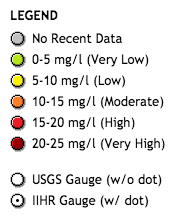
Q3. Is dark red different than the light red?
Yes. The color indicates a range of nitrate (NO3-N) + nitrite (NO2-N) concentration.
Q4. What is the EPA limit for nitrates?
The maximum contaminant level (MCL) in drinking water as nitrate (NO3) is 45 mg/l, whereas the MCL as NO3-N is 10 mg/l. The MCL is the highest level of NO3 or NO3-N that is allowable in public drinking water supplies, as regulated by the U.S. Environmental Protection Agency (EPA).
Q5. If a dot is dark red, does that indicate the water is dangerous to drink?
Nutrient pollution can be harmful in groundwater if it is used as a drinking water source.
Q6. How do I tell the difference between IIHR sensors and USGS sensors?
The circle sensor markers that contain a black center dot are USGS sensors, while those without the dot are IIHR—Hydroscience and Engineering sensors.
Q7. Why are some of the dots gray?
Gray dots indicate that there is no recent data for this site.
Q8. Can I see information about where the sensors are, the drainage area, etc.?
The watershed area is highlighted when you click on the circle sensor marker.
Q9. How do I access graphs for water quality data?
Click on a circle water quality sensor marker. A graph for Recent Nitrate (NO3-N) + Nitrite (NO2-N) data is shown in the upper left corner of the screen. Click on More Data to access the other recent available data parameters. For data beyond the 15-day window, please contact Martin St. Clair.
Q10. How is water quality data used?
Water quality data are used to assess the condition of Iowa streams, quantify the effectiveness of conservation practices, and track progress toward water quality improvement goals.
Q11. Does IWQIS work on all web browsers?
Developers designed IWQIS using the latest web technologies and tested it on all major browsers. Please use the latest version of your web browser. IWQIS provides a better user experience on the Google Chrome web browser at higher screen resolutions.
Q12. Who should I contact if IWQIS functions do not work properly on my computer?
Contact Martin St. Clair for water quality related questions, or Jerry Mount with general system questions. Please provide details of the problem (how to repeat the error, what you see [and expect to see] during the error) and your browser information (browser name, version, operating system, etc.).
Q13. Can I suggest a new function or a new data source (USGS stream gage, etc.)?
Yes. Please contact us at the emails above with your suggestions.