
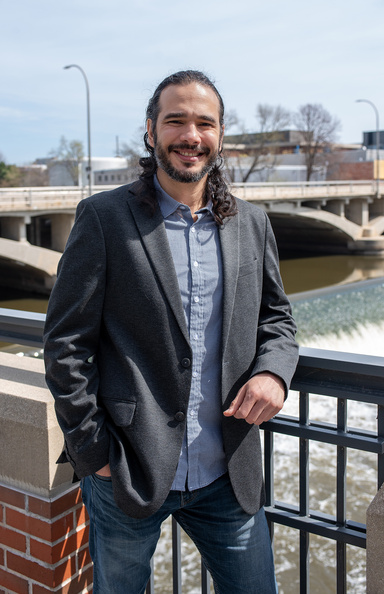
Humberto Vergara has long dreamed of bringing reliable flash flood forecasting to countries around the world.
Vergara is an assistant professor of civil and environmental engineering, an IIHR research engineer, and associate director of the Iowa Flood Center. He received a $1.2 million grant from the World Meteorological Organization; the project is a continuation of a previous $162,000 project for West Africa.
Vergara and his team are continuing to develop a flash flood forecasting system that he initiated earlier in his career; the current project is helping to make early flood warnings a reality in Comoros (an island off the east coast of Africa), Cuba, Haiti, Barbados, Guatemala, and Antigua and Barbuda.
Flash flooding
Predicting flash floods is challenging because they happen so fast, Vergara says. In many places, there are essentially no rainfall observations to guide the development of hydrologic modeling and improved forecasting tools.
“You have to be creative and clever,” he explains.
Precipitation is the single most important variable or quantity that Vergara and his team need to forecast flash flooding effectively.
“But we all know that’s extremely difficult to estimate,” Vergara says. When no radar rainfall data are available, forecasters must rely on satellite observations. These can provide a good alternative, although there are limitations to their accuracy.
“My position on that is it’s better than nothing,” Vergara says. “Satellite data definitely have the potential to save lives and crucial infrastructure.”
He adds, “While you’re waiting for the perfect information, people can die. So rather than wait for the perfect precipitation data, you move ahead with what you have available. And we are creating tools that will communicate information that decision-makers can use.”
Sharing the data
Vergara and his team are partnering with Tethys Geoscience Foundation and Aquaveo, which specialize in training and support for online information-sharing platforms, similar to the Iowa Flood Information System (IFIS).
“They are going to develop an IFIS-like platform so our partners in the different countries can actually interact with the data our systems will generate in real time,” Vergara says.
He hopes the project will expand and develop into long-term relationships and more opportunities to work closely with the countries involved.
“I would like to continue expanding some of these same efforts to other countries,” he says. “I would love to be able to do this for my country, Colombia, and or other countries in South America.”
New perspectives
One of Vergara’s doctoral students, Vanessa Robledo, recently received $130,000 ($50,000 this year) in fellowship funding from NASA to continue her research on the predictability of flash floods.
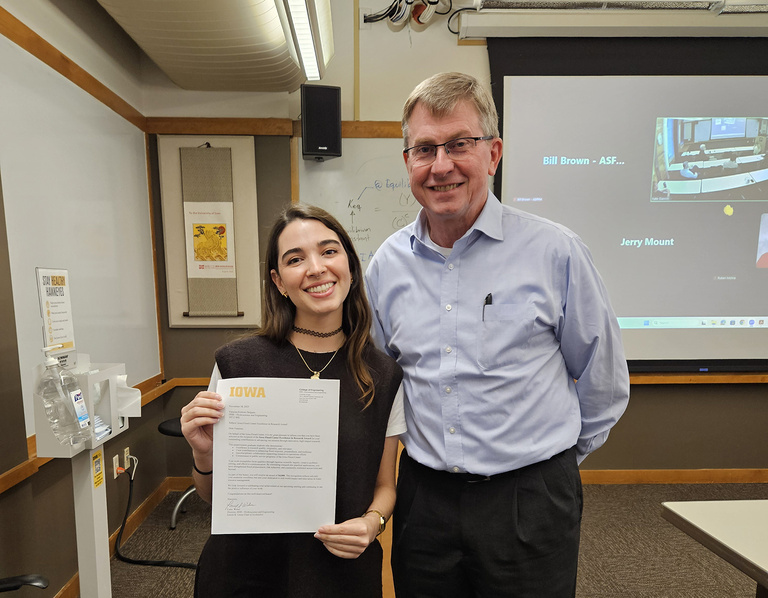
“She’s looking deep into the science, into the current understanding and new insights the data can provide,” Vergara says. Her results could eventually contribute to new tools or methodologies that forecasters can apply.
Vergara says he’s proud to see Robledo receive this competitive fellowship. “She has a lot of potential. She’s going to go far in her career, I’m sure.”
Vergara admits that it’s been challenging for him to adjust to being the team leader, rather than the hands-on guy. “I’m still dealing with the fact that I don’t have my hands directly on data,” he says. “But through my team’s work, I’ve been able to enjoy it from a different point of view.”
Early warning for all
Vergara is especially excited about a United Nations (U.N.) initiative called “Early Warning for All,” championed by the WMO and other international agencies, including the U.N. Office for Disaster Risk Reduction (UNDRR), the International Telecommunication Union (ITU), and the International Federation of Red Cross and Red Crescent Societies (IFRC). (Vergara also worked with the Red Cross on related efforts as part of a NASA project in Ecuador.)
Early Warning for All aims to provide life-saving advance warnings of dangerous weather, flooding, and climate events to everyone, everywhere, by the end of 2027.
“I believe that what we offer is a way to realize or to really accomplish the objectives of that initiative,” Vergara says.
He’s still passionate about the work. “For a long time, I’ve been excited about bringing some of these capabilities and technologies to places where they don’t have a lot of infrastructure. For me, that is the reward.”