
Pesticide Use in Iowa
Pesticides are products used to kill, reduce, or keep away unwanted plants, insects, fungi, and other pests. They are grouped by the type of pest they control. For example, herbicides control weeds and other unwanted plants, insecticides control insects, and fungicides control fungal disease. These pesticides play an important role in agricultural production across Iowa.
U.S. law requires the Environmental Protection Agency (EPA) to approve pesticides before they are used or sold, though the EPA does not guarantee that an approved pesticide is risk free. There is growing evidence that exposure to certain pesticides may increase the risk of adverse health outcomes, including cancer.
Monitoring conducted across Iowa shows that pesticide residues can move beyond the fields where they are applied. Rainfall runoff, tile drainage, and pesticide drift can transport agricultural chemicals into rivers, streams, and other water resources. Monitoring also detected pesticides in urban environments and household dust, demonstrating the many pathways through which people and ecosystems may be exposed.
Iowa INSIGHT investigates the occurrence of pesticides in Iowa’s water and air to better understand potential exposure risks for Iowans. By identifying when, where, and at what levels pesticides are present in the environment, this research informs management practices, good decision-making, and guides strategies to protect both environmental quality and public health.
Press Release

New UI Study Finds Pesticides in Iowa’s Water, Air, and Homes
Get the Facts
- Iowa uses more pesticides than almost any other state. Between 1992 and 2018, an estimated 34 to 72 million pounds of pesticides were applied to Iowa’s landscape to help control weeds, insects, and crop diseases.
- Most pesticides used in Iowa are herbicides (weed killers). About 90% of pesticide use is aimed at controlling weeds. Common herbicides include atrazine, acetochlor, glyphosate (the active ingredient in Roundup), and metolachlor. Other common herbicides are 2,4-D, dicamba, mesotrione, and isoxaflutole.
- Insecticides and fungicides are also widely used. Although applied in smaller amounts than herbicides, these products have become increasingly common since the late 1900s. Many are applied as seed coatings to protect crops from insects and disease during early growth.
- Rain can carry pesticides into waterways. After pesticides are applied, rainfall can wash them from fields into nearby rivers and streams. As a result, pesticide levels in Iowa’s waterways are often highest following spring rainstorms.
- Pesticides used in Iowa can enter waterways and groundwater used as drinking water sources. Certain herbicides used in Iowa can enter waterways and groundwater. Public water systems regularly monitor for these chemicals to ensure drinking water meets federal regulations and remains safe for consumers. Unregulated private wells, especially shallow wells, are likely more vulnerable to contamination. Commonly monitored herbicides include alachlor, atrazine, 2,4-D, glyphosate, and simazine. Alachlor, which is no longer widely used, is the only one of these herbicides regulated because of concerns about cancer risk.
- EPA approval does not mean a pesticide is risk free. Under federal law, the EPA must review and approve pesticides before they can be sold or used in the United States. The EPA bases its approval of a pesticide on whether the benefits of using it are judged to outweigh its potential risks to people and the environment. However, EPA approval does not guarantee that a pesticide is risk free. Scientists continue to study the potential effects of pesticides on human health and the environment. In some cases, pesticides have been restricted or removed from use after EPA approval as new research becomes available.
- Scientific understanding of pesticide risks continues to evolve. Researchers are continually learning more about how pesticides behave in the environment and how they may affect human health. For example, atrazine remains approved for use in the United States, but concerns about its potential health and environmental impacts have led more than 60 countries, including those in the European Union, to ban or phase out its use. Ongoing research helps inform decisions about pesticide management, regulation, and public health protection.
Pesticide Monitoring: What We Know
Researchers at the Center for Health Effects of Environmental Contamination (CHEEC) and IIHR—Hydroscience and Engineering are studying pesticide occurrence in Iowa’s water, air, and homes to better understand how people and ecosystems may be exposed to these chemicals.
Monitoring Pesticides in Surface Water
- Since 2024, researchers at CHEEC have partnered with watershed management authorities in northeastern Iowa to monitor the occurrence of common herbicides, insecticides, and fungicides (Figure 1). Neonicotinoid insecticides were widespread in Iowa streams. These chemicals affect the nervous system of insects and are commonly used on corn, soybean, and other crop seeds before planting.
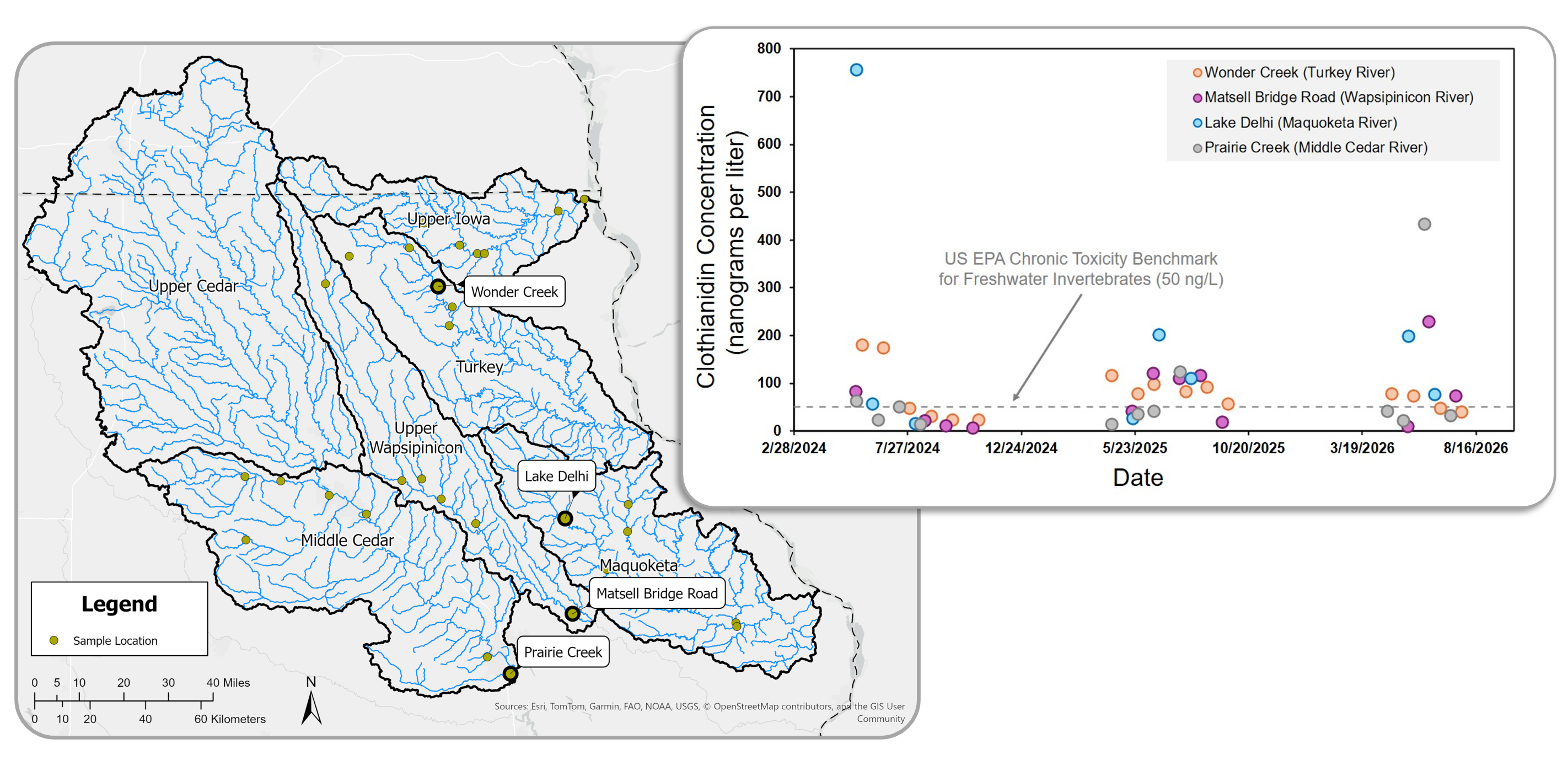
- Across 193 surface water samples collected from 2024–2026, clothianidin was detected in 98% of samples, and imidacloprid was detected in 82%. Concentrations of these insecticides frequently exceeded the EPA’s chronic toxicity benchmarks for aquatic invertebrates, such as aquatic insects and other small stream organisms. Specifically, 42% of clothianidin measurements exceeded the EPA benchmark of 0.05 micrograms per liter, while 13% of imidacloprid measurements exceeded the benchmark of 0.01 micrograms per liter. These findings suggest that neonicotinoid insecticides may pose a risk to aquatic biodiversity in Iowa’s rivers and streams.
Herbicides were also commonly detected. Among 98 samples analyzed in 2025 and 2026, atrazine was found in 91% of samples, and metolachlor was found in 78% of samples. The highest atrazine concentration measured was 3.49 micrograms per liter in Prairie Creek in the Middle Cedar Watershed in June 2026, exceeding the EPA drinking water standard for atrazine of 3 micrograms per liter.
Monitoring Pesticides in Leaves
Researchers are studying how pesticides move through the air into urban areas. In 2026, CHEEC researchers collected leaves from nine sites across Iowa City to evaluate pesticide drift and deposition from the surrounding environment (Figure 2). Because leaves act like natural collectors of airborne particles, they can provide evidence of pesticides that have traveled through the air and settled in urban areas.
A.) Public Parks

B.) Elementary Schools across Iowa City

- Pesticides were detected on nearly all leaf samples. The fungicide azoxystrobin was found in 98% of samples, while the herbicide atrazine was detected in 96% of samples collected between late May and mid-August. These findings show that agricultural pesticides can drift beyond the areas where they are applied.
Pesticide levels changed throughout the growing season. Atrazine concentrations were highest in early summer, while fungicides were most common later in the season. This pattern reflects how these products are typically used in agriculture, with atrazine applied earlier in the growing season and fungicides often applied to soybean fields during mid-to-late summer.
Monitoring Pesticides in Household Dust
- Researchers are studying how pesticides may enter homes. CHEEC recently completed a pilot study involving 28 households across Iowa to better understand how pesticides in the environment may contribute to exposure through household dust.
- Several pesticides were commonly detected in household dust. Preliminary results from 60 indoor dust samples found the fungicide azoxystrobin in 80% of samples and tebuconazole in 57% of samples. The insecticide imidacloprid was detected in 79% of samples, while the herbicides metolachlor and atrazine were found in 37% and 32% of samples, respectively.
These findings suggest that pesticides can enter indoor environments through multiple pathways. The findings also highlight the importance of understanding how environmental contamination may contribute to everyday exposure. Additional analysis is underway to better understand the implications for human health.
Summary of All Monitoring Results
- The same pesticides were often found in water, air, and indoor dust. Monitoring of streams, leaves, and household dust showed that many pesticides occur together as complex mixtures rather than as individual chemicals (Figure 3). The herbicides atrazine and metolachlor were commonly detected in both surface water and leaf samples, with atrazine also found in approximately 30% of indoor dust samples.

- Several neonicotinoid insecticides were widespread. The insecticides clothianidin, imidacloprid, and thiamethoxam were frequently detected in surface water, while imidacloprid was also found in nearly 80% of indoor dust samples. In addition, several fungicides, including azoxystrobin, flutriafol, metalaxyl, propiconazole, pyraclostrobin, and trifloxystrobin, were detected on at least half of all leaf samples.
- Researchers also found pesticide breakdown products, known as metabolites, in surface water. These included breakdown products of fungicides and neonicotinoid insecticides, such as azoxystrobin free acid, clothianidin-n-desmethyl, and desnitro-imidacloprid. Although metabolites are not routinely included in many monitoring programs, some may persist longer in the environment or be more mobile than the original pesticides from which they were formed.
- Several pesticides were detected across all three sample types. For example, azoxystrobin was found in 60% of water samples, 98% of leaf samples, and 80% of indoor dust samples. Imidacloprid was detected in 82% of water samples, 13% of leaf samples, and 79% of dust samples, while atrazine was found in 91% of water samples, 96% of leaf samples, and about 32% of dust samples.
- The recurring detection of the same pesticides in water, outdoor environments, and homes suggests that Iowans may be exposed through multiple pathways. The frequent detection of these pesticides increases the likelihood that Iowans are being exposed to chemicals that research has linked to effects on the nervous system (azoxystrobin) and endocrine disruption (atrazine). Understanding where these chemicals occur and how people may encounter them is an important step toward protecting environmental and public health.
What do the Study Results Mean?
Monitoring across Iowa shows that pesticides commonly occur in rivers and streams, on urban vegetation, and even in household dust. Several pesticides were repeatedly detected across all three environments, suggesting that people and wildlife may be exposed to multiple pesticides through various pathways.
Some of the most frequently detected pesticides were found at levels that may be harmful to aquatic insects and other organisms that are important to healthy stream ecosystems. Researchers also found evidence that pesticide drift and deposition can carry agricultural chemicals into parks, schools, and neighborhoods, highlighting that pesticide movement is not limited to fields where products are applied.
While these findings do not show that people are experiencing adverse health effects, they do indicate that pesticide exposure is widespread and can occur through water, air, and indoor environments. The presence of multiple pesticides and their breakdown products in the environment demonstrates the importance of continued monitoring and research to better understand potential risks to both environmental and human health.
Key takeaways
- Pesticides were frequently detected in Iowa surface waters, urban environments, and homes.
- Several pesticides were found across multiple environmental media, indicating multiple opportunities for exposure.
- Some pesticide concentrations in surface water exceeded levels considered protective of aquatic life.
- Pesticide drift and deposition can transport agricultural chemicals into schools, parks, and residential areas.
- Continued monitoring is needed to better understand long-term impacts on ecosystems and human health.
Steps Iowa Can Take to Better Understand and Reduce Pesticide Exposure
- Improve public access to information about pesticide use. Information about where and how pesticides are used can help communities, researchers, and decision-makers better understand potential environmental and health impacts. Although the Iowa Department of Agriculture and Land Stewardship collects pesticide-related information, including sales data, much of it is not publicly available. Some states have adopted more transparent approaches. For example, California provides public access to both historical pesticide use records and notifications about upcoming pesticide applications. Making more pesticide use information available in Iowa would improve environmental monitoring, help identify potential exposure risks, and support research on where pesticides occur and how people may come into contact with them.
- Increase state-led pesticide monitoring across Iowa. Regular monitoring helps track where pesticides are found in the environment and whether they may pose risks to people, wildlife, or water quality. Publicly available information from the Iowa Department of Natural Resources shows that pesticide monitoring in Iowa’s rivers, streams, and lakes has been conducted inconsistently over the past two decades, with several years (2007–2011, 2017, and 2021–2023) during which no state-led monitoring took place. Some widely used pesticides have received very limited attention. For example, neonicotinoid insecticides were monitored only in 2015 and 2016, while glyphosate, one of the most commonly used pesticides in Iowa, was monitored in surface waters only once (2001). Other states, including Minnesota and California, operate more comprehensive monitoring programs that track pesticides in surface water, groundwater, rainfall, and air. Expanding pesticide monitoring in Iowa would provide a clearer picture of where these chemicals occur, how long they persist in the environment, and how exposure patterns may be changing over time.
- Create pesticide notification programs for sensitive populations. Many people would like to know when pesticides are being applied near their homes, schools, or workplaces, especially those who are sensitive to chemical exposures. Some states already provide advance notice of nearby pesticide applications. For example, Florida offers a notification program for residents who identify as chemically sensitive, while California allows residents to sign up for email or text alerts before certain pesticides are applied nearby. Establishing similar programs in Iowa could help people, especially those in sensitive populations, take steps to reduce unnecessary exposure, while also increasing public awareness and community engagement around local pesticide use.
- Build state-led programs to understand Iowans' pesticide exposure. Environmental monitoring alone cannot fully determine how much pesticide exposure people experience. Biomonitoring can provide a clearer picture of exposure levels among different groups of people. These efforts should be combined with studies that examine the many ways people can come into contact with pesticides, including through drinking water, work activities, pesticide drift from nearby applications, and exposures inside homes through air and dust. Better information on human exposure can help guide public health decisions and identify opportunities to reduce risk.
How will Iowa INSIGHT Help?
Expand testing for commonly used pesticides. INSIGHT scientists are developing new methods to detect some of Iowa's most widely used pesticides that are not currently routinely monitored, including glyphosate, 2,4-D, dicamba, glufosinate, and breakdown products of atrazine and metolachlor.
Increase pesticide monitoring in Iowa waters. INSIGHT will work with partners across the state to expand pesticide monitoring in rivers, streams, and other water resources. Integrating pesticide testing with existing water-quality monitoring sites will provide more frequent and geographically widespread information.
Monitor pesticides in air and indoor environments. INSIGHT will broaden environmental monitoring to include pesticides in the air, rainfall, dust, and on indoor surfaces. These efforts will help identify where pesticides travel and accumulate after application.
Develop tools to measure human exposure. INSIGHT will advance biomonitoring capabilities that measure pesticides or their breakdown products in blood, urine, and other biological samples. These tools will support studies aimed at better understanding links between pesticide exposure and human health.

Monitoring Pesticides in Iowa
PDF coming soon!
Research Contributors
Iowa INSIGHT contributors: Darrin Thompson, Marty St. Clair, Wenjing Xi, Dan Gilles, Holden Carter, Julia Moody, and David Cwiertny.
Acknowledgements: Iowa INSIGHT would like to acknowledge Audrey Tran Lam, environmental health program director at the University of Northern Iowa’s Center for Energy and Environmental Education, for reviewing and providing comments on this report.
About Iowa INSIGHT
This research is supported by the Iowa Integrated Network for Science, Information, and Geospatial Health Tracking. The program is dedicated to driving solutions to improve the health and resiliency of Iowa's environment and its people.