
In his 42 years at the University of Iowa, Larry Weber has helped transform Iowa into a more flood-resilient state where people have access to innovative tools and reliable, science-based information about flood conditions and water resources.
For these accomplishments and many others, the University of Iowa presented Weber with its most prestigious honor, the Hancher-Finkbine Medallion, at a dinner and celebration held on April 7 at the Iowa Memorial Union.
Weber is the Edwin B. Green Chair in Hydraulics in the Department of Civil and Environmental Engineering (CEE) and director of IIHR—Hydroscience and Engineering (IIHR) and the Iowa Flood Center (IFC).
“I cannot think of anyone more deserving of the Hancher-Finkbine Medallion,” says Allen Bradley, UI professor of civil and environmental engineering. “Larry’s career reflects the highest ideals of learning, leadership, and loyalty to the University of Iowa.”
Early days

An Iowa native, Weber grew up on a small farm near Dyersville, Iowa, and came to the University of Iowa as an undergraduate in 1984. If it weren’t for the farm crisis in the 1980s, Weber says, he might be a farmer today. Instead, he chose to study engineering at the University of Iowa — in no small part because of his enthusiastic support for the Hawkeye football team.
Today, Weber remains a proud Hawkeye. He earned BS, MS, and PhD degrees at Iowa, all in civil and environmental engineering. In 1996, Weber joined the College of Engineering faculty. It was the start of a career that continues to have a powerful impact on the university, generations of students, and the state of Iowa and its citizens.
As a faculty member and researcher, Weber helps build the next generation of scholars and water professionals. He has advised 53 MS students, 25 PhD students, and 12 postdoctoral researchers. His academic achievements have earned recognition at the highest levels of the American Society of Civil Engineers (ASCE), including election as an ASCE Fellow and receipt of the 2018 Hunter Rouse Hydraulic Engineering Award.
A trusted voice
In 2004, Weber took on the role of director of IIHR. He stepped away from the role in 2017, returning in 2022. In total, he has served as director for nearly 17 years, and under his leadership, the institute has grown and thrived.
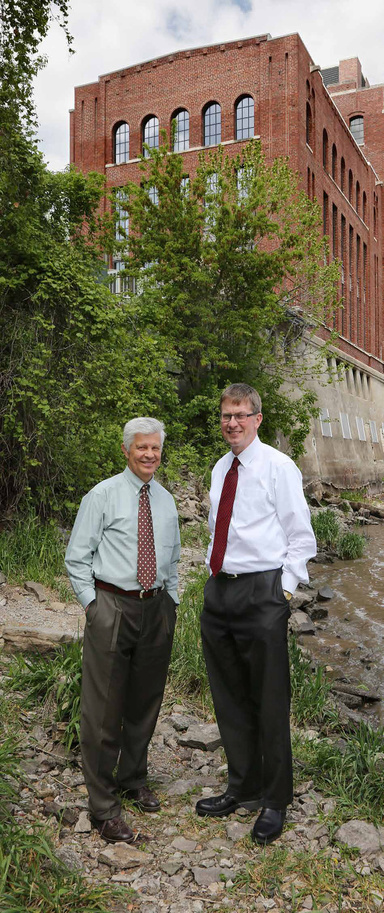
For example, after the Iowa flood of 2008, Weber joined with CEE and IIHR faculty colleague Witold Krajewski to co‑found the Iowa Flood Center (IFC) — the nation’s only state‑funded academic center devoted to flooding. The IFC has helped Iowans become better informed and more flood resilient. The IFC makes real-time information on river levels, flood forecasts, and risk factors available to all through the Iowa Flood Information System. Thanks to these efforts and more, Iowa communities are more prepared for flooding.
“So much grew out of [the 2008 flood]. It unified the lab. We had a common purpose. We were able to work with intention,” Weber says.
The IFC is just one of the innovative new research directions that emerged during Weber’s tenure. In 2013, he helped establish the Iowa Nutrient Research Center (INRC) based at Iowa State University. With INRC funding, IIHR built a statewide network of water quality sensors that feed data directly to the Iowa Water Quality Information System, on online platform that gives Iowans access to real-time water quality information. The INRC has also supported more than 150 water quality projects statewide, including edge-of-field, nutrient management, and land management efforts.
Weber spearheaded the Iowa Watershed Approach, a five-year project that engaged partners and watersheds statewide to enhance Iowa’s flood resilience and improve water quality. He also led a team of researchers that produced the Central Iowa Water Quality Report (CISWRA), a groundbreaking scientific study of the Raccoon and Des Moines rivers commissioned by the Polk County Board of Supervisors. CISWRA is the most comprehensive analysis of water quality in Central Iowa to date. The research team made a series of public presentations around the state to share the results, which were attended by thousands of people in person and online.
Weber’s work on these projects and his sustained engagement with leaders, stakeholders, and the media have made him a trusted public voice on flood mitigation and water quality issues.
Empowering others
Weber has given generously of his time and expertise to the university. For instance, after the 2008 flood, he co‑chaired the university’s Flood Mitigation Task Force. Over four years, the task force provided critical technical guidance for flood recovery and future planning.
Weber also served as executive associate dean of the College of Engineering, where he led several major initiatives, including fundraising efforts and the naming of the Roy J. Carver Department of Biomedical Engineering.
A colleague and friend
Michelle Scherer, former UI professor of civil and environmental engineering and IIHR researcher, says Weber is known for giving encouragement and support to colleagues. “A true leader inspires and empowers others to reach for the moon,” Scherer says. “That is Larry’s superpower.”

Krajewski, who worked closely with Weber for many years, says the honor is well deserved. “Professor Weber exemplifies leadership, learning, and loyalty in everything that he does. He brings distinction to the University of Iowa, and I am proud and fortunate to call him my friend and colleague.”