
Even though Corin Fuchtman has only worked at IIHR—Hydroscience and Engineering for about a year, he says the experience has already changed his life.
The University of Iowa student joined the IIHR communications and outreach team last fall. He was new to communications, but now he’s comfortable performing a variety of duties and frequently presents to researchers, K-12 students, and other groups.
Fuchtman has also conducted research in flood science and performed fieldwork. Not bad considering he didn’t know anything about IIHR when he applied for the job.
“Which is kind of hilarious in retrospect,” he says. “I feel lucky to have stumbled across IIHR.”
Family influences
Fuchtman grew up in Cedar Falls, Iowa, with his parents and three siblings, and they remain the most significant influences in his life.
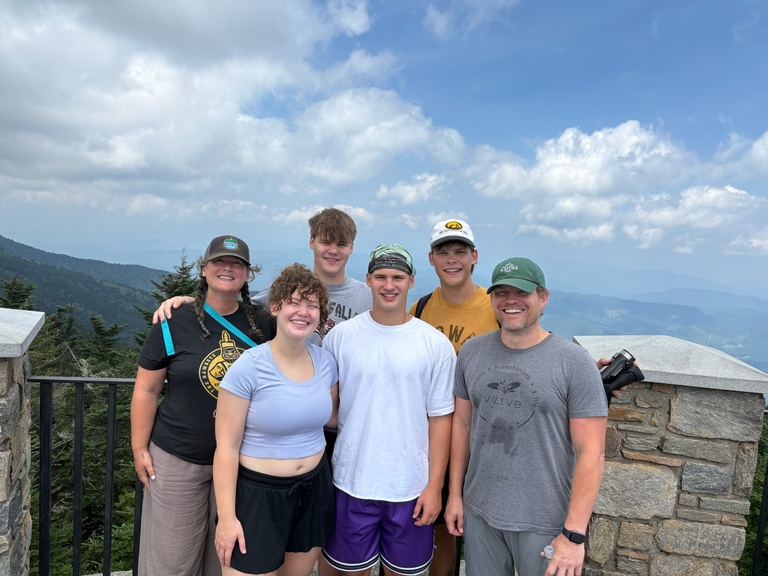
Fuchtman’s mother, Heidi, inspired him to get involved with the nonprofit she co-founded, Youth Art Team, which empowers young people through art. Fuchtman’s work with the program didn’t just benefit the kids; it also opened his eyes to the power of art to express feelings, tell a story, and build community.
His older sister, Emma, has also been an inspiration. “She’s someone who has always been almost perfect academically,” Fuchtman says. “She’s been really encouraging me to strive for what I want to do.”
Pigskin Dreams
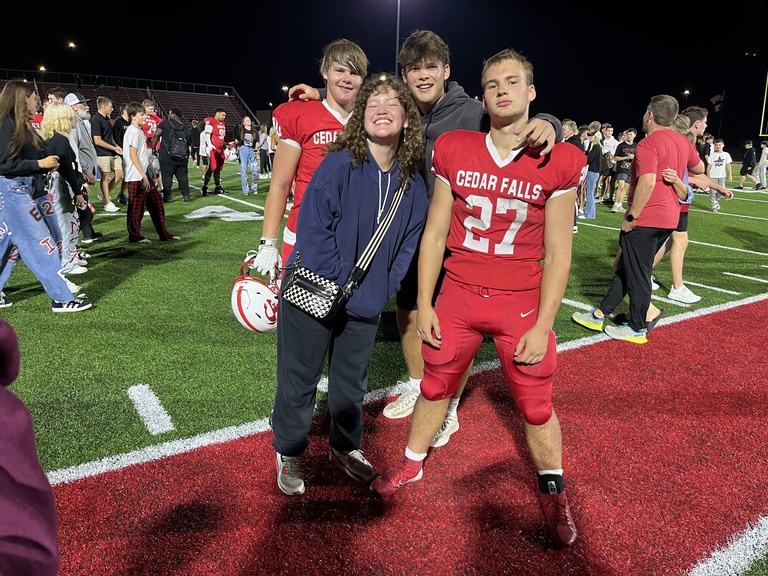
For a long time, though, what Fuchtman wanted to do was play football. He and his two younger brothers would play two-handed touch football all day, every day if they could.
When Fuchtman was old enough for tackle football in middle school, he couldn’t wait to go out for the team.
But there was a problem.
“My parents really did not want me to play,” he says. “I begged and begged. I remember putting a note in my Christmas stocking.
“All I wanted for Christmas was to play football.”
Finally, they agreed. But then COVID intervened, and all sports were off for the duration. By 10th grade, Fuchtman says, he couldn’t wait to get back on the field.
“That was another conversation where I had to beg and beg,” he says. Ultimately, he succeeded and played fullback until he graduated in 2024.
AmeriCorps
After high school graduation, Fuchtman spent a summer volunteering with AmeriCorps. Every Tuesday, he worked at the Peoples Community Health Clinic Garden, planting and weeding with family friend Kamyar Enshayan, who is the former director of the Center for Energy and Environmental Education (CEEE) at the University of Northern Iowa.
With plenty of time to talk, Enshayan told Fuchtman about his own career and his advocacy for restricting construction in floodplains as well as the environmental studies opportunities at the University of Iowa.
Fuchtman says his AmeriCorps experience opened his eyes to the importance of community-level interaction with environmental issues.
“Seeing the direct impact I had on communities led me to want to continue spreading positivity and contributing to a sustainable environment, leading me to choose environmental sciences at Iowa.”
On to Iowa

As a college student at the University of Iowa, Fuchtman wanted to find a job that would offer experience related to his environmental science major, and he was happy to land a position at IIHR.
At first, though, the work was out of Fuchtman’s comfort zone. He has learned a lot since then and now handles a variety of tasks for the communications team, including K-12 outreach presentations demonstrating rainfall and flooding using a tabletop watershed model.
Kids really respond to the watershed demonstration, Fuchtman says, and he enjoys sharing his appreciation for science with them. He loves seeing the students’ faces light up when they learn something new.

Fieldwork

In summer 2026, Fuchtman’s work at IIHR expanded to include fieldwork. His first day in the field was a blistering hot summer day that might have scared off most students. Fuchtman drove his own car to the Des Moines area to join Iowa Geological Survey researcher Matthew Streeter and his team to drill a monitoring well. After that, the team pushed on another two and a half hours to southwest Iowa, where they drilled several more wells, a few of which had to be hand-augered.
Then, on the long drive home, Fuchtman got a flat tire in the pouring rain.
But the rough start didn’t dampen his enthusiasm. He’s also done fieldwork with Jim Niemeier’s team, repairing and deploying weather monitoring instruments for Iowa Flood Center (IFC) hydrostations.
Fuchtman also worked with IIHR researcher Mohamed Abdelkader on a project for the IFC. At the end of summer, he presented his project, “A Multi-Source Dataset for Evaluating Flood Experiments and Impacts in Iowa,” at an Iowa Flood Center meeting. Fuchtman also hopes to present the project at the American Geophysical Union meeting in San Francisco later this year.
Working at IIHR has opened Fuchtman’s eyes to a future he hadn’t previously imagined. He’s now planning to apply to graduate school in engineering.
“Coming here and getting to see the work they’re doing here has definitely made me want to continue in the College of Engineering,” Fuchtman says. “I don’t think I would have gone to graduate school if I didn’t work here. So that’s been pretty amazing. “