
In October, a group of about 10 visitors from Minnesota trekked south to Iowa City to learn more about IIHR’s successful Iowa Flood Center (IFC).
The Minnesotans represented universities, state and federal agencies, and research institutions. They came with a mission: to create a Minnesota version of the flood center. They were determined to learn everything they could from IFC Director Larry Weber and other IFC staff and researchers.
Even at the end of an afternoon of non-stop presentations about nearly every aspect of the IFC, the guests from Minnesota wanted to keep the conversation going. Questions popped up from every corner of the room for almost a full hour of lively discussion.
That kind of engagement reflects just how important the subject is, and how great the need, not just in Minnesota or Iowa, but in every state across the country.
Serving Minnesota
Rachel Pichelmann, a hydraulic resiliency engineer at the Minnesota Department of Transportation (MDOT), explained the reason for the urgency. When floods happen, she said, it can be a struggle for Minnesotans to make informed decisions without coordinated, centralized information resources.
“We don’t have a singular place to go,” she said. “How can we fill the gaps?”
Kristy Dellwo of the Minnesota Division of Homeland Security and Emergency Management agreed and stressed the need for a one-stop shop for flood information, much like the IFC’s Iowa Flood Information System.
Nick Olson of the Minnesota DOT mentioned the need for collaboration between agencies and organizations.
“We’re all trying to serve Minnesota,” he said.
The genesis of the IFC
Weber told the story of the IFC’s creation after the flood of 2008, which cause about $10 billion in damage to eastern Iowa, and $1 billion to the University of Iowa campus. State legislators called on Weber and IFC co-founder Witold Krajewski to develop a proposal to help Iowans prepare for future flooding.
Perhaps the time was right, because their proposal became state law, and the Iowa Flood Center was born.
“Maybe we caught lightning in a bottle,” Weber said.
The IFC is based at an academic institution: IIHR—Hydroscience and Engineering and the University of Iowa. The academic setting offers flexibility and agility that may be difficult to reproduce elsewhere, Weber explained.
“We provide information,” Weber said. IFC’s professional staff are committed to being available to support communities before, during, and after flood emergencies, he explained.
Resources and reflections
The Minnesota team also heard from other IFC staff members about topics such as IFC’s network of stream sensors and weather instruments, flood forecasting and mapping, and IIHR’s statewide water quality monitoring network.
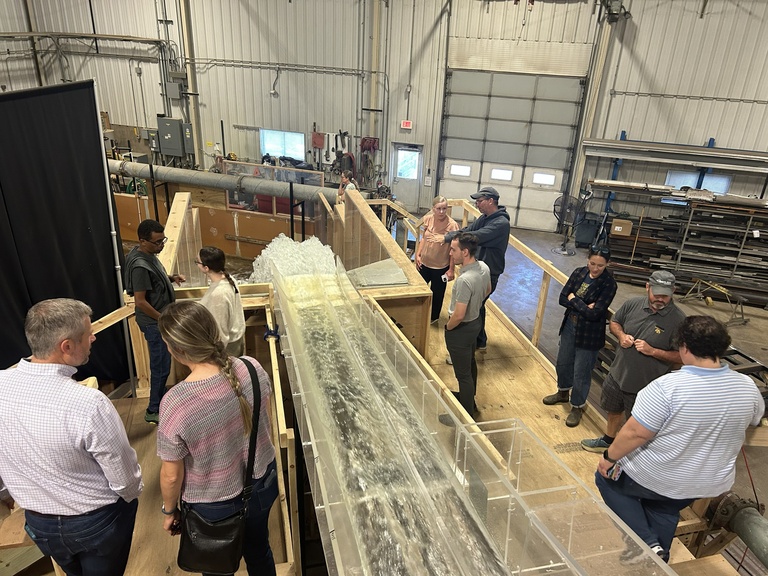
After a tour of IIHR research facilities led by IIHR Associate Director Troy Lyons, the meeting was over. But all parties agreed that continued communication and collaborations would benefit both groups.
Giannini said it perfectly. “There is strength in these partnerships and collaborations.”