Arsenic Risk in Iowa
Arsenic is a naturally occurring element found in Iowa’s underground rock and soil deposits. Its presence in groundwater is influenced by the state’s diverse landscape and geologic formations. Because arsenic is colorless, tasteless, and odorless, it cannot be detected without testing. When present at elevated levels, long-term exposure can pose serious health risks.
Iowa INSIGHT provides county-level and localized data to help homeowners, public health professionals, and decision-makers better understand arsenic risks across the state. This research also identifies gaps in private drinking well monitoring to support targeted testing efforts and inform prevention strategies.
Press Release

Free Arsenic Testing Available for Iowa Private Well Owners
Arsenic in Private Wells
Get the Facts
The U.S. Environmental Protection Agency (EPA) classifies arsenic as a chemical known to cause cancer in humans. Studies have linked arsenic ingestion to cancers of the skin, bladder, and lungs. It has also been associated with skin lesions, diseases of the circulatory system (the heart and blood vessels), diabetes, and effects on the development of babies and young children.
- The EPA has set a legal limit of 10 micrograms per liter (µg/L) for arsenic in public drinking water systems. However, because arsenic can be harmful even at very low levels, the EPA's public health goal is to eliminate all arsenic in drinking water.
- Private wells in Iowa are not regulated, and testing well water for arsenic is voluntary. The exact number of private well users in Iowa is uncertain. Based on the most recent Iowa Department of Natural Resources estimates, about 177,000 Iowans, or 5.5% of the state's population, rely on private water supplies at their homes.
- Because of Iowa's unique landscape, arsenic is not found at the same levels across Iowa. Higher concentrations are most common in north-central Iowa. Where you live can affect your risk of exposure to arsenic in well water.
What We Know
- Between 2014 and 2024, testing for arsenic was conducted at 22,133 unique wells in Iowa through the Iowa Private Well Grants program.
About 11% of Iowa wells that have been tested have exceeded the 10 µg/L maximum contaminant level under the Safe Drinking Water Act (Figure 1). This water is unsafe to drink. Another 8.4% of Iowa wells fall between 5–10 µg/L, where emerging research suggests that health risks may still be elevated. For these wells, more frequent monitoring is needed to account for potential changes in water quality that could result in unsafe drinking water.
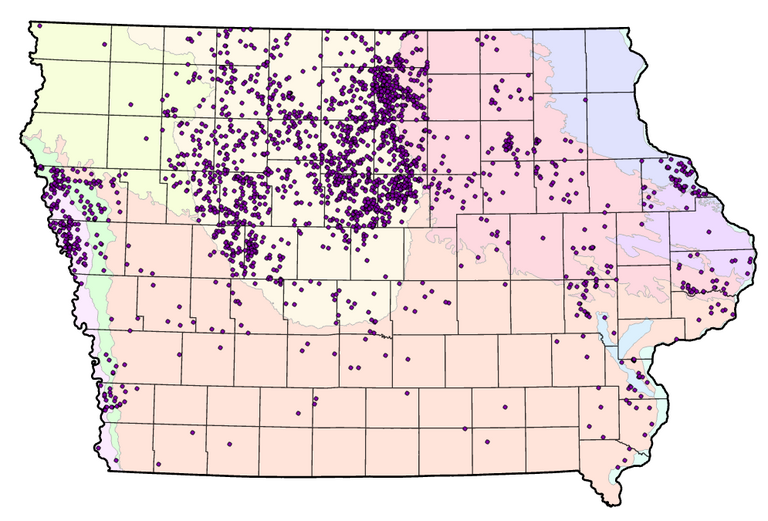
Figure 1. Location of private wells with at least one water sample testing at or above the EPA's maximum contaminant level for arsenic of 10 10 µg/L. The map excludes data from Buchanan County collected in 2016 due to potential data quality issues. Also shown, in color, are Iowa’s major landform regions. - North central Iowa—Cerro Gordo, Franklin, Hardin, Hamilton, Hancock, Kossuth, and Calhoun counties—show the highest instances of well water exceeding EPA limits for arsenic (Figure 1). Several other locations across Iowa frequently report arsenic values above the legal limit, including Dubuque, Buchanan, Woodbury, and Monona counties. These elevated levels in well water result from the natural occurrence of arsenic in the geologic formations underneath each county.
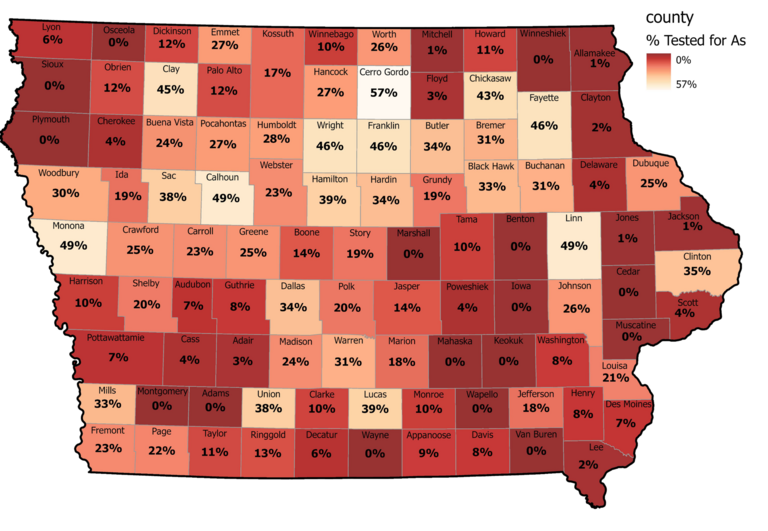
- Several counties have limited arsenic testing data. Figure 2 shows the percentage of wells registered in the Iowa Well Information System (IWIS) that had an associated arsenic test between 2014 and 2024. Counties with notably low testing include Mitchell, Floyd, Plymouth, Jones, Cedar, and Benton. This is particularly concerning because these counties border areas where well testing has frequently identified elevated and unsafe arsenic levels. Because arsenic occurrence is influenced by geologic formations that extend across county boundaries, the absence of testing data should not be interpreted as evidence of low risk. Comprehensive testing is needed to determine whether groundwater in these counties is affected by arsenic.
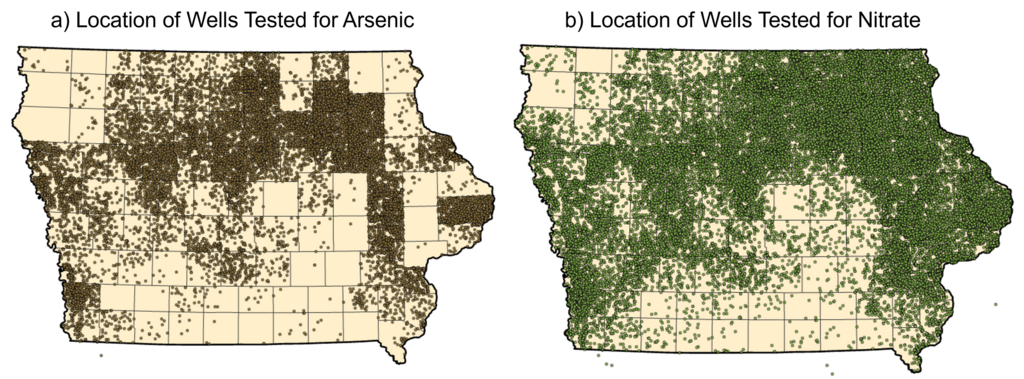
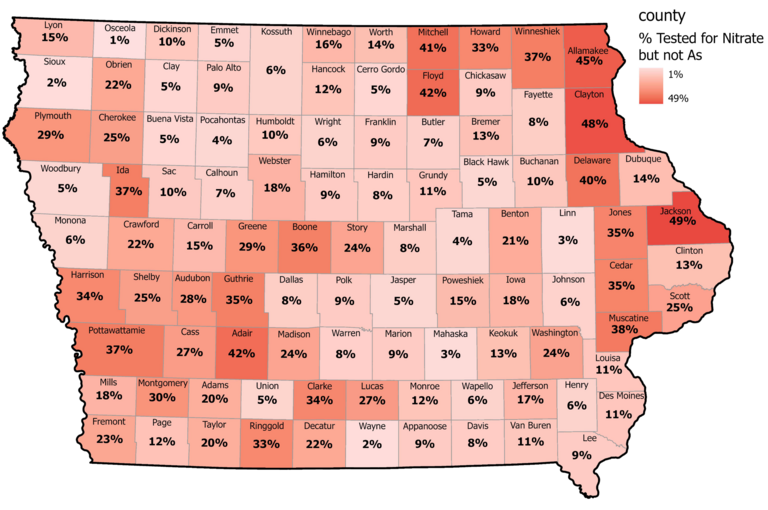
- A comparison of arsenic (Figure 3a) and nitrate tests (Figure 3b) in IWIS between 2014 and 2024 reveals that several counties with limited arsenic testing data have been active in private-well nitrate testing, including those adjacent to arsenic hot spots. Figure 4 shows, by county, the number of IWIS-registered wells that have been tested for nitrate but not arsenic; the counties in darker red tested more frequently for nitrate than arsenic. In these counties, environmental health specialists who are sampling private wells for nitrate could expand arsenic coverage by collecting an additional water sample for arsenic testing.
- Importantly, arsenic is not just a problem for private wells. Analysis of 8,210 Safe Drinking Water Act compliance tests from 1,256 Iowa public water systems (2000–2024) shows that about 8% of tests exceeded legal limits.
Recommendations for Decision Makers
Increase funding for the Private Well Grants Program to expand access to arsenic and other contaminant testing for Iowa well owners.
Support proactive outreach by public health agencies to encourage private well testing for arsenic, especially in counties where little testing has been done. This is particularly important in areas that share similar geology with counties where high arsenic levels have already been found.
Enable counties to implement local policies and educational initiatives that raise awareness of arsenic risks in private wells. For example, counties can adopt policies similar to those used in Cerro Gordo County. Policy recommendations include: 1) building wells that avoid underground areas known to contain high levels of arsenic; and 2) requiring arsenic testing when homes with private wells are sold, especially in higher-risk areas.
Provide financial incentives for well users to install in-home treatment systems to remove arsenic from their drinking water. For example, in 2024, Nebraska passed the Reverse Osmosis System Tax Credit Act, which provides a tax credit to well users who install a reverse osmosis (RO) system in their primary residence. The credit covers 50% of the installation cost, up to $1,000, making these systems more affordable for families. RO systems can also remove chemicals and pollutants, such as nitrates, from drinking water.
How Can I Test or Treat My Water?
If your home gets water from a private well, you should have your water tested for arsenic, especially if few wells in your area have been tested. In Iowa, free arsenic testing may be available through the Private Well Grants Program, which is managed by local county health departments.
If your well water contains more than 10 micrograms per liter (µg/L) of arsenic, a reverse osmosis filter installed at a drinking water tap is usually the most practical and affordable solution. Some homes may need more extensive treatment to remove iron and manganese before using RO, as these metals can plug RO filters. Additional pre-treatment may also be needed to convert arsenic to a form more readily removed by RO treatment. Be sure to work with a trained water treatment professional to find the right treatment system for your water. Common pitcher filters, such as Brita filters, and whole-house carbon filters do not remove arsenic.
Another option is to connect to a local rural water system, if one is available in your area (for example, the Poweshiek Water Association serves Benton County). These systems are regulated and regularly tested to help ensure safe drinking water.

Request an Arsenic Home Water Testing Kit
Assess the risk of arsenic in your private drinking water well.
What do my results mean?
Greater than 10 µg/L
Exceeds the federal drinking water standard.
Your arsenic result is greater than 10 µg/L, which exceeds the U.S. EPA maximum contaminant level of 10 µg/L for drinking water. Drinking water with this concentration of arsenic has been linked to health risks including increased incidence of bladder, lung, and skin cancers. Arsenic may also cause cardiovascular disease, and adverse birth and developmental outcomes.
We recommend you stop drinking this water and consult a water treatment professional to install a system capable of removing arsenic. If you do not install treatment, we recommend connecting to a rural water provider, if available in your area. You may also use bottled water for drinking and preparing food.
Your local public health department can also provide additional support and resources for addressing arsenic in your drinking water.
You can continue to wash dishes with your water; arsenic retained on dishware after washing is very low. You can also continue to bathe or shower, as arsenic is minimally absorbed through the skin.
After installing treatment, retest to confirm it is working, then at least annually while you rely on it. You may request a follow-up test kit after you've installed treatment. Please email iowa-insight@uiowa.edu or visit iihr.uiowa.edu/iowa-insight to apply for a second test kit.
Between 5 and 10 µg/L
Below the federal drinking water standard, but of concern.
Your arsenic result is between 5 and 10 µg/L. Although below the federal limit of 10 µg/L, this level is still of concern. Two states — New Jersey and New Hampshire — have set enforceable limits of 5 µg/L. EPA's health-based but non-enforceable public health goal for arsenic is set at zero, reflecting that the 10 µg/L standard is not fully protective of health, and efforts should be taken to eliminate arsenic from water whenever possible. Long-term exposure at this level may increase health risks, including bladder, lung, and skin cancer, cardiovascular disease, and adverse birth and development outcomes.
We recommend you consult a water treatment professional in your area to install a system capable of removing arsenic. If you do not wish to install treatment, we recommend connecting to a rural water provider, if available in your area. You may also use bottled water for drinking and preparing food. If you elect to not install treatment or use an alternative water source, we do not recommend drinking or cooking with water that is cloudy and colored (red, brown, or black) because the particles causing that appearance may concentrate arsenic.
Your local public health department can also provide additional support and resources for addressing arsenic in your drinking water.
You can continue to wash dishes with your water; arsenic retained on dishware after washing is very low. You can also continue to bathe or shower, as arsenic is minimally absorbed through the skin.
After installing treatment, retest to confirm it is working, then at least annually while you rely on it. You may request a follow-up test kit after you've installed treatment. Please email iowa-insight@uiowa.edu or visit iihr.uiowa.edu/iowa-insight to apply for a second test kit.
Detected, below 5 µg/L
Arsenic is present at low levels. Meets all current drinking water standards for arsenic.
Arsenic was detected in your water at a level below 5 µg/L. Current evidence suggests concentrations in this range are less likely to cause health concerns. If you are concerned, you may consult a water treatment professional to install a system capable of removing arsenic, seek a different source such as rural water, if available in your area, or use bottled water for drinking and preparing food.
Your local public health department can also provide additional support and resources for addressing arsenic in your drinking water.
You can continue to wash dishes with your water; arsenic retained on dishware after washing is very low.You can also continue to bathe or shower, as arsenic is minimally absorbed through the skin.
We do not recommend drinking or cooking with water that is cloudy and colored (red, brown, or black) because the particles causing that appearance may concentrate arsenic.
Test your water regularly — at least once every three years — to understand if arsenic levels change over time.
Not detected (< 0.2 µg/L)
Meets all current drinking water standards for arsenic.
Arsenic was not detected in your water. That means your result was below the smallest amount of arsenic that our laboratory method can detect (called our method quantitation level of 0.2 µg/L or 0.0002 mg/L). Your water meets all current drinking water standards for arsenic.
Test your water regularly — at least once every three years — to understand if arsenic levels in your water change over time.
About Iowa INSIGHT
This research is supported by the Iowa Integrated Network for Science, Information, and Geospatial Health Tracking. The program is dedicated to driving solutions to improve the health and resiliency of Iowa's environment and its people.