
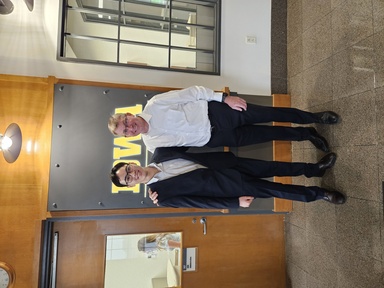
Kento Sugiyama recently set a record as the youngest student to present at the Iowa Flood Center’s weekly meeting. In fact, he was the first.
On August 5, the Iowa City West High School student shared his project, “Community-Oriented Data Integration and Communication Framework for Streamflow Forecast Models and Flood Inundation Map Products,” at the weekly IFC meeting.
“It was extremely impressive,” says Kate Giannini, program manager at IIHR—Hydroscience and Engineering and the Iowa Flood Center. “Kento clearly has a great future ahead of him.”
Recognizing a need
Sugiyama’s interest in flooding started early.
When the Tohoku earthquake and tsunami struck his native Japan in 2011, Sugiyama was only three years old. He was too young to remember it, but the stories his parents told him brought the deadly natural disaster to life in his imagination.
Later, growing up in Iowa City where his father had joined the University of Iowa College of Engineering faculty, Sugiyama learned about the 2008 Iowa flood, which caused almost $1 billion in damage to the UI campus and $10 billion statewide.
Sugiyama saw a significant need, and he wanted to help.
Now a rising high school senior, Sugiyama is applying his interests and aptitude in mathematics, science, and web-based technologies to real-world challenges, working to make a difference for people and communities facing natural disasters.
“I just realized that this was a huge concern and something that we have to address,” Sugiyama says.
Harnessing technologies
As a high school junior, Sugiyama reached out to former UI faculty member Ibrahim Demir, who led the development of the Iowa Flood Information System at the UI’s Iowa Flood Center. Now at Tulane University, Demir directs the Hydroinformatics Lab there and serves as a professor of river-coastal science and engineering.
Demir opened Sugiyama’s eyes to the ways information technologies — including AI and other emerging tools — can be put to work for people facing flood-related disasters.
Demir also introduced the high school student to Carlos Erazo Ramirez, a PhD student at the time and now a postdoctoral fellow at Tulane. Ramirez’s research focuses on hydroinformatics and computational hydrology.
He and Sugiyama began a groundbreaking collaboration that produced a web-based flood inundation mapping and GIS system, HyMES-FIM.
Quantifying flood risk and damage
Sugiyama wanted to create an online flood information system that could produce real-time flood mapping and scenario-based damage assessments on a national scale. And he wanted it to work for ordinary people, using standard computers and normal internet access.
The project took advantage of openly available federal datasets; by bringing all this information together, Sugiyama and Ramirez created a national-scale system to generate flood risk assessments and real-time flood inundation mapping, overlaid with damage assessments.
The system can also work offline. Users can prepare the system in advance to be available when the internet or cell service goes out.
Sugiyama is quick to point out that their system isn’t meant to replace high fidelity, physics-based models such as the Iowa Flood Information System.
“The idea was, how can we make a system that works at the national scale and provides a ‘good enough’ extent?” Sugiyama says.
Using this simplified approach, they’ve been able to achieve good results.
Sugiyama gives great credit to both his mentors, Ibrahim Demir and Carlos Erazo Ramirez, for the success of his project.
“Their support has been invaluable,” Sugiyama says.
For his part, Ramirez has nothing but positive comments about his young collaborator. “He is extremely eager to learn and has lots of initiative and leverages the latest technologies to his advantage. I can see he will have a bright future and hopefully can continue moving toward this.”
Their research was recently published in Environmental Modelling & Software.
Getting noticed
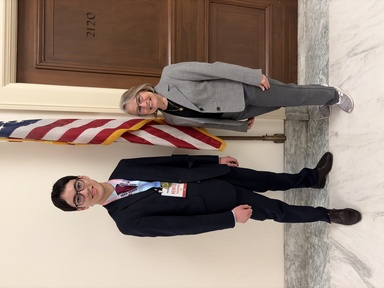
Sugiyama’s work has garnered plenty of interest.
He was selected to participate in an online summer program at MIT in 2026 that focused on remote-sensing and GIS. The four-week course culminated in a team project to model a fictional hurricane, including logistics, public information, and planning as well as modeling.
“I got perspective on how the whole process works,” Sugiyama says.
He also took part in the Congressional App Challenge. Sugiyama was invited to attend a conference in Washington, D.C., in April 2026. His app was one of the top six overall from nearly 400 district-winning apps, and it was named the Community Impact Winner.
What’s next?
With such a major achievement already under his belt, Sugiyama is looking forward to attending college next year. He’s not sure exactly where his studies will take him, but he wants to continue his focus on water resources, geosciences, civil engineering, and atmospheric science.
Congratulations, Kento! We can’t wait to hear more about your career.